
Meet the Press: A Profile of Mollie McFee, Associate Editor at the University of Chicago Press
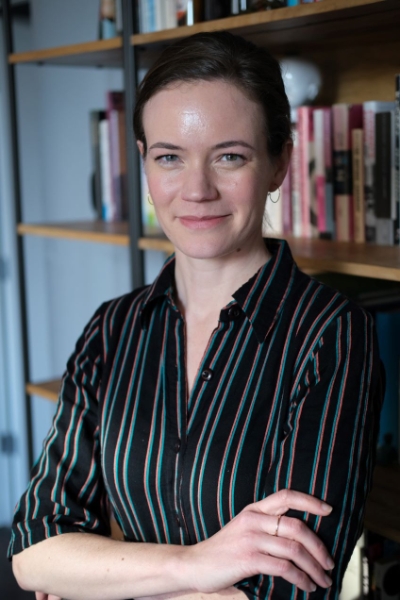
How does a book lover become an acquisitions editor? What does it mean to think like an editor, as opposed to a scholar? Why does an editor’s relationship to the author matter? Mollie McFee answers these questions as she discusses her path to becoming an associate editor.
Mollie McFee, like many people who want to work in publishing, has always loved books. Unlike some, McFee also had an interest in academia, inspired by her grandparents’ scholarly ambitions. This drove her to pursue a degree in comparative literature at the University of Chicago in 2011. After completing her PhD, she found that publishing would allow her to stay close to research and scholarship. After consulting an alumnus of her PhD program who had worked at the Press, she began working there as a promotions assistant in the marketing department. The position offered a broad view of all the books published at the press as well as the individuals, media outlets, and organizations interested in them. “I read every single page of the catalog. I feel like I knew a little bit about every book that we published, and I also was fielding all of the review copy requests,” said McFee. After about a year, she moved into being a promotions manager, which involved considering who the audience of a book would be.
Eventually, McFee made her way into acquisitions as an editorial associate, eager to “get into the nitty-gritty of the ideas.” Under Elizabeth Branch Dyson, Chicago’s sociology and education editor, she bridged the gap between her scholarly background and publishing. McFee said, “I developed a model that maps onto what more of the acquiring editors do at the Press, and I saw how an editorial perspective differed significantly from a scholarly perspective.” That new perspective, developed as she stepped outside of her intellectual background, also helped her to step out of the weeds of her specialty, zoom out, and survey the work being done in a new discipline.
In her current role, she looks for books that stand to contribute to the field by bringing important subject matter and analytical approaches to the table. This creates depth for future researchers. “I always take into account what research we are making available and how it is going to benefit scholars in the field,” said McFee. These skills, combined with her training in comparative literature, allowed her to acquire in ethnomusicology, as she felt prepared to think across cultures and languages. Finally, in 2026, she became the associate editor responsible for Chicago’s books in music and media studies, where she has again had to reorient herself to the field, its developments, and its opportunities to acquire interesting books.
“Often when I talk to people pursuing PhDs who are interested in publishing, there tends to be an assumption that one will move from doing a PhD in X field to acquiring books in X field,” said McFee. While that can be the case, McFee finds that even if it’s not, there is no reason to be disappointed. “Sometimes the field you work in can be a little bit of a happy coincidence; you’re always negotiating what kind of material you want to be working with and what kind of institution you want to work for within publishing. There are a lot of factors to consider, but I consider it an added bonus that I love music, and I’ve always had a personal connection to music.”
McFee attributes her ability to acquire strong books in music partially to her ability to operate as an outsider to the field. While she possesses an analytical lens, there is less personal investment when evaluating the books and greater ability to draw connections, allowing their aspirations to shine through. “I really admire books that are trying to make a really ambitious argument or tell a really ambitious story, and that draw from a wide array of source material,” said McFee.
However, that ambition is only one element that McFee considers when acquiring the book. The second is whether a book fits institutionally. “You’re always building on the list you’ve inherited, and I’m lucky to have excellent cornerstones. I’m also always looking to see where a field is going and pursuing titles that introduce new materials or approaches,” said McFee. As a result, it’s often challenging to answer authors’ questions as to whether she is acquiring books on a specific topic; the answer is more often dependent on how the subject matter is analyzed rather than the topic itself. Often, McFee finds that books may start in a narrow or specialized topic only to reveal surprising insights, which she attributes to a strong author.
The relationships with the scholars themselves are another element; McFee notes that often she sees promise in a book and wants to work with its author to draw it out. “One of my favorite aspects of the job is talking to people about the significance of their project and what they want their readers to learn from it,” said McFee.
Another aspect of the work is administrative in nature: how to make the finances of a book work. Often that can mean being upfront with an author about book length, production changes, and approachability. “I try my best to look for additional funding, find strategic cuts in the writing, search for alternative production methods, and explore logistical options,” said McFee. While she notes that part of the job isn’t as glamorous, it’s equally fulfilling.
One book that is representative of McFee’s standards as an editor is The Sound of Thinking by Craig Dworkin. The book explores different pieces of music that are composed to center chance or happenstance; an artist’s creativity is ceded to process. Organized alphabetically, each chapter discusses prominent composers and their ideas by breaking down the musical concepts. “Dworkin is a poet and literary critic; he did not come out of a music department, which makes the book more approachable and less alienating,” said McFee.